Diagnostic guides
How to find a high voltage isolation fault on an electric bus or EV
By Sebastian Rivera
The short answer
Make the high voltage system safe, then use an insulation tester to measure between each high voltage conductor and chassis. A healthy circuit reads very high, often in the gigaohm range. When a reading drops, disconnect components 1 at a time and test again. When isolation comes back, the last thing you disconnected is the path to the fault.
Safety. High voltage work is only for trained, qualified technicians. Follow the manufacturer's procedure to de-energize the system, lock it out, wear rated PPE and verify zero voltage before any test.
From a real job
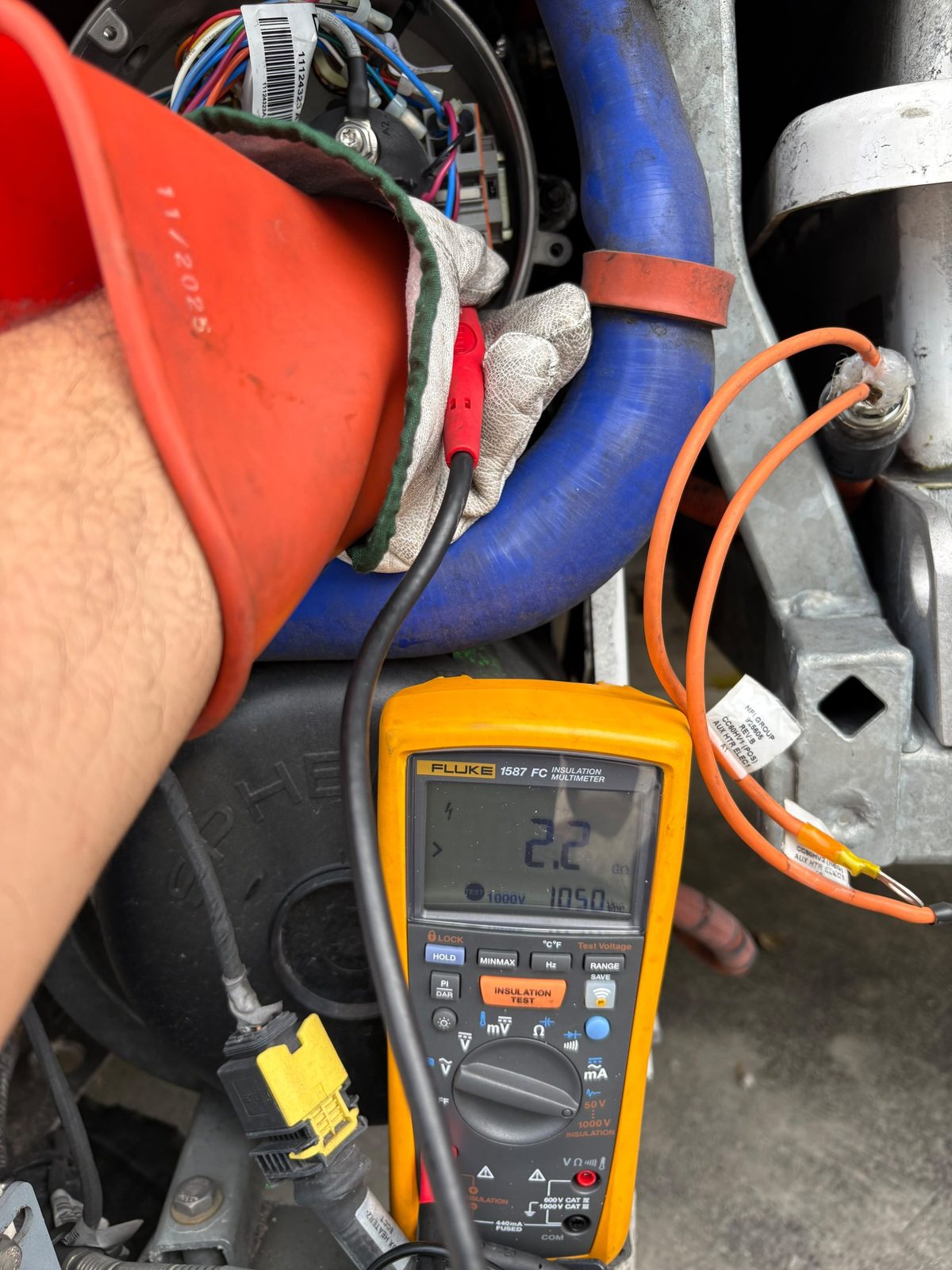
On this job, the A1 post of a high voltage auxiliary heater lost isolation with its control connector plugged in. An internal short in the heater's contactor was letting high voltage back through the control wires into that connector. With the connector unplugged, the A1 post read 2.2 GΩ at a 1000 V test again. The fault was inside the contactor, not in the high voltage cabling.
How to do it
- Make the system safe. De-energize the high voltage system following the manufacturer's procedure, lock it out and verify there is no voltage present.
- Set up the insulation tester. Select the test voltage the manufacturer specifies for that system, commonly 500 V or 1000 V.
- Test each conductor to chassis. Measure each high voltage positive and negative to chassis ground and note every reading.
- Split the circuit. When a reading is low, disconnect components and connectors 1 at a time and test again from the same point.
- Find what restores isolation. When the reading comes back up, the part you just disconnected is in the leakage path. Then confirm the fault inside that part.
Minimum acceptable insulation values depend on the manufacturer and the system voltage, so always compare against their spec, not a general number. See more diagnostic cases.